
Egg freezing at Onto Health
Egg Freezing: Keep Your Options Open
You don’t have to know if - or when - you want kids to think about your fertility.
Egg freezing (also called oocyte cryopreservation) lets you preserve your eggs now, so you have more choices later - for age-related fertility decline, career or education timing, an upcoming medical treatment, or simply not having met the right partner yet.

Egg freezing isn’t about pressure or predicting exactly what your future looks like.
It’s about understanding where your fertility stands today - so tomorrow has more options in it.
Understanding egg freezing
What is egg freezing?
Egg freezing, also called oocyte cryopreservation, is a fertility preservation option that allows you to freeze and store your eggs for potential future family building.
During the egg freezing process, eggs are retrieved from the ovaries and rapidly frozen using a technique called vitrification. When you're ready to use them, the eggs can be thawed, fertilized with sperm and used to create embryos through IVF.
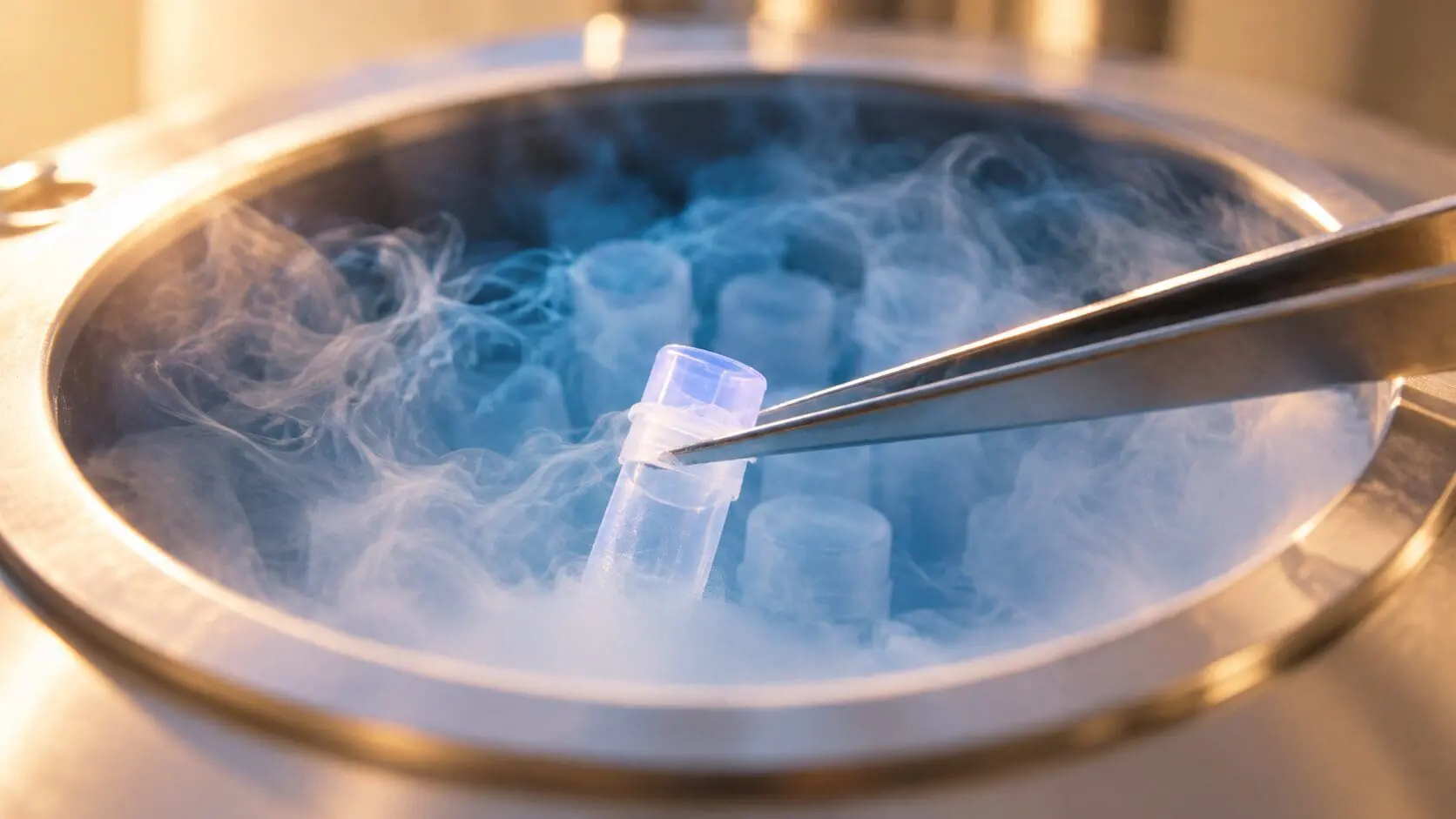
Modern egg freezing uses vitrification - a rapid-freezing technique designed to protect eggs during cryopreservation.
Who considers egg freezing?
People choose to freeze their eggs for a range of reasons, including:
- Age and future fertility planning
- Not having the right partner yet
- Career or education
- Financial timing
- Not feeling ready for children
- Medical treatment
- Endometriosis or other health conditions
- Family history of early menopause
- Future family-building goals
- Simply wanting more options
The process, step by step
How does gg freezing work?
Initial consultation and fertility testing
Bloodwork (including AMH, a hormone that reflects ovarian reserve) and a pelvic ultrasound check your antral follicle count. Together these give a picture of your current egg supply — not your egg quality, which testing can’t fully predict.
Ovarian stimulation
For about 10–14 days, hormone injections stimulate your ovaries to produce multiple eggs in a single cycle. Regular monitoring — bloodwork and ultrasounds — lets your provider adjust medication and time the next step precisely.
Egg retrieval
A short outpatient procedure (about 15–20 minutes, under sedation) retrieves the eggs using a thin needle guided by ultrasound. Patients go home the same day and return to normal activity within a day or two.
Vitrification and storage
Mature eggs are flash-frozen via vitrification within hours of retrieval, then stored in liquid nitrogen at -196°C (-320°F) until you're ready to use them — which could be years later.
Planning ahead
How many eggs should you freeze?
There’s no one-size-fits-all number. These factors can make a difference:

Your age
Egg quantity and quality change over time.

Your ovarian reserve
Testing can help estimate how many eggs you may retrieve in a cycle.

Your family-building goals
Hoping for one child or more can affect the number of eggs you may want to preserve.
Your egg-freezing goal is personal. Your Onto team can use your age, fertility testing and future family-building goals to help estimate how many eggs you may want to freeze — and whether that could take one retrieval cycle or more.

When you’re ready
What happens when you’re ready to use your frozen eggs?
When you decide to grow your family, your frozen eggs are thawed and checked for survival — vitrification typically gives high post-thaw survival rates, which is a major reason it replaced older slow-freeze methods.
Surviving eggs are fertilized with sperm using ICSI (a single sperm is injected directly into each egg), and fertilized eggs are cultured for several days to see which develop into viable embryos. From there, the process continues like a standard IVF cycle: a resulting embryo is transferred to the uterus, with the goal of pregnancy.
Not every frozen egg will survive thawing, fertilize, or result in a pregnancy — which is exactly why the number and age of eggs frozen matters so much, and why your care team will talk with you honestly about realistic odds for your situation.
What the research shows
Egg freezing success rates: what the research shows
Success rates depend heavily on your age at the time of freezing. The largest study to date — following more than 1,100 patients who returned to thaw their eggs — found live birth rates of:
Froze at age 35–37
Froze at age 38–40
Froze at age 41–42
Froze after age 42
Lower odds per added year of age
The takeaway isn’t that there’s a “cutoff” age — it’s that earlier is generally better, but egg freezing can still offer a meaningful chance at a future family well into your late 30s and 40s.
The only way to know where you personally stand is a fertility evaluation — which is exactly what your free consultation covers.
Source: ASRM Scientific Congress, 2025.
Before you book
Frequently asked questions about egg freezing
Is egg freezing painful?
Most of the discomfort is limited to the hormone injections (similar to a pinch) and mild bloating during stimulation. The retrieval itself is done under sedation, so you won’t feel it; some cramping afterward is normal and typically resolves within a day or two.
What’s the best age to freeze your eggs?
Right now! Generally, the earlier you freeze your eggs, the better their quality and quantity. The best time depends on your age, fertility health and future family-building goals.
How much does egg freezing cost?
Egg freezing costs vary based on your location, treatment plan, medications and storage needs. Visit our pricing page to explore your options.
Do frozen eggs expire?
No! When properly stored, frozen eggs can remain preserved for many years without a known expiration date.
Will I need to do more than one retrieval cycle?
This depends on your age, ovarian reserve and family-building goals. Some patients choose one cycle, while others may benefit from additional retrievals.

Not sure if egg freezing is right for you? That’s exactly what the consultation is for.
Book a free consultation with Onto Health to understand your fertility today — no pressure, no obligation, just information.